Riverland
Roughly one glass in three of all Australian wine starts here. 21,816 hectares of irrigated Murray vineyard, the largest planting in the country, and a third of the national crush leaves it every year.
Known for
- Chardonnay
- Shiraz
- Cabernet Sauvignon
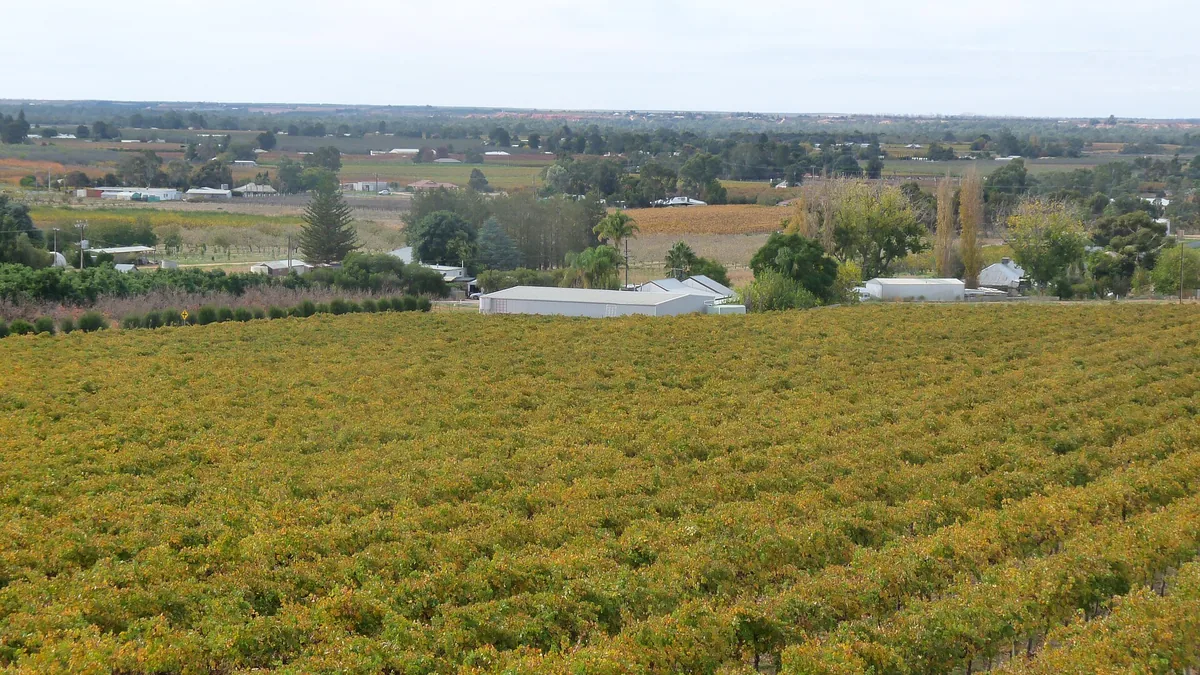
Why Riverland tastes the way it does
Hot, dry and flat, with little growing-season rain, so everything depends on irrigation from the Murray. Heat and water together give very high yields and soft, ripe fruit made for drinking young. Most of it is blended and sold without the region's name on the label.
January averages 24.9°C here and the growing season adds up to 2,332 heat units, which is hot, and the fruit ripens fast.
A short history
Irrigation settlements along the Murray began in the 1880s, and soldier-settlement schemes after both world wars put thousands of returned servicemen onto small irrigated blocks. Wine grapes followed dried fruit, and by the end of the twentieth century the Riverland was carrying Australia's export boom.
Riverland was registered as a protected wine name in 1998, which makes the boundary a legal definition rather than a marketing one.
What your house does to a bottle from Riverland
A bottle from Riverland ages at the rate its temperature sets, not at the rate the vintage chart says. Barello's model is the physical one: every 10°C above 13°C roughly doubles the rate, and at 25°C or more you are not ageing it, you are cooking it. Pick where you live and where the bottle actually sits.
Choose a city and a spot, and this line will tell you how much faster the bottle is ageing than it would in a cellar.
This is the same model that dates every bottle in Barello. Open the app to run it against your own wine. Or read how to store wine without a cellar, or the wine temperature chart.
Riverland in numbers
| Planted vineyard | 21,816 ha | number 1 of 64 in Australia |
|---|---|---|
| Region area | 4,105 km² | 5.31% of it under vine |
| Grapes crushed | 517,413 t a year | 23.7 tonnes a hectare |
| January average | 24.9°C | number 59 coolest of 64 |
| Heat units | 2,332 | warmth added up over the growing season |
| Land in the GI rises | 0 to 99 m | the boundary, not where the vines are |
| Registered | 1998 | as a protected name |
Nearby
- Eden Valley122 km west, 3.0°C cooler
- Barossa Valley132 km west, 2.1°C cooler
- Clare Valley161 km west, 2.0°C cooler
Distances are between the registered centres of each region, so they are as the crow flies rather than as the road goes.
Where these numbers come from
Boundaries and figures: Wine Australia Geographical Indications register, used under CC BY 4.0. Climate figures are the register's own long-run averages, measured in the vineyard. The history and the tasting notes above are Barello's own.